The problem: gradients die at events
Differentiable simulation has a failure mode worse than an exception. It returns confident, finite, wrong gradients, and it does so wherever the dynamics are event-driven: contact, impact, switching, thresholds.
The reason is structural. The parameter-dependence of the event time contributes a term to the sensitivity, the saltation term, that autodiff of a time-stepping program cannot see, because the step at which the event fires is an integer and is piecewise-constant in the parameters.
Measured, three ways
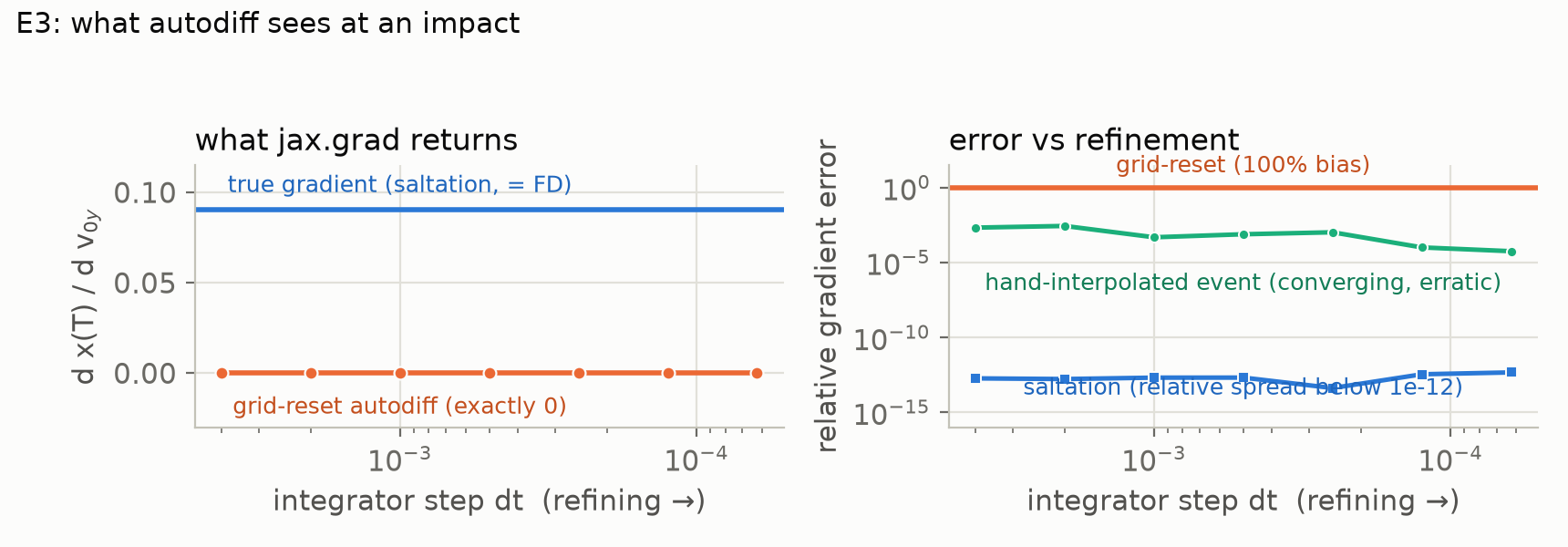
Plotted from e3_rows.npy by make_figures.py.
A pure-JAX simulation of a bouncing ball (RK4 scan, reset applied at the grid
point via jnp.where) converges to the correct trajectory as dt shrinks,
and reports d x(T)/d v0y = 0.0 at every resolution. The true value is
+0.0904, pinned independently by the symbolic closed form used in the
verification studies.
The exact zero is specific to this configuration, state-independent resets over flat terrain. On curved terrain the same program returns a nonzero wrong value instead, which is harder to notice.
The steelman
The honest repair inside pure JAX is to interpolate the crossing time from the guard and reset at the interpolated state. That recovers a converging gradient, and it is the point rather than a counterexample: the repair is first-order event-time sensitivity machinery, hand-implemented. Its error is dt-dependent and non-monotone (2×10⁻³ down to 6×10⁻⁵ across our sweep), and every new guard and reset pair owes its own derivation.
What JAX already does
To be precise about the ecosystem, since this is the first question a JAX user asks. Diffrax has differentiated event times since v0.6.0, by implicit differentiation through an Optimistix root find, so a single event is handled natively and correctly.
What is missing is the rest of a hybrid trajectory. diffrax.Event terminates
a solve and has no reset map, so a multi-impact chain has to be assembled by
restarting the solver after each event and applying the reset in user code.
That route is expressible and, done correctly, it works: we measured the
restart pattern and Diffrax returns the exact gradient, provided the jump time
is closed over differentiably. What the caller takes on is the bookkeeping,
the reset, the restart, and the differentiable jump time, for every impact.
Diffrax issue 729
is what happens when that bookkeeping is got wrong; the measurements are on
the comparison page.
Rather than hand that bookkeeping to the caller, impact-adjoint puts the event-aware machinery behind a component boundary. See the method.